Nov 15, 2026 I Elias Mercer
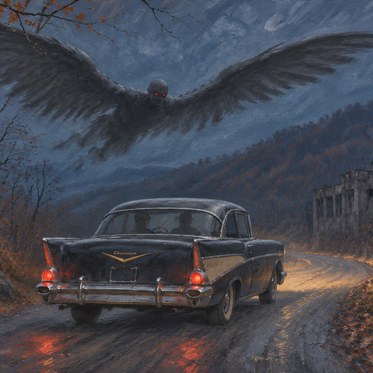
The road had nothing beneath it. A. S. Wiltse could see a forest below its surface and a river running through the valley, yet the pale roadway held his weight. He examined its mixture of milky quartz and fine sand, even picking up a piece of gravel. He felt well enough to walk uphill without tiring. Only a short time before, as he remembered it, he had been desperately ill. Now he believed he had left his body and was travelling towards another world. Ahead, three enormous rocks blocked the way.
Wiltse was an American physician who described this experience after severe typhoid fever in 1889. His medical-journal account encompassed both the illness and the extraordinary journey he remembered. While others attended the patient, Wiltse found himself in a landscape detailed enough to invite a walker’s attention: the slope of a road, the coolness after rain and the resemblance of mountains to places he already knew.
His recollection began with an apparent separation from his body. He described emerging from his head, floating, then finding himself standing beside the bed. Attempts to attract the attention of the people around him failed. He went through the doorway, down the steps and into the street, noticing the red soil and the marks left by rain. The extraordinary experience initially retained the geography of an ordinary departure from home. There was a porch to cross and a path to follow before the journey became unfamiliar.
After another break in awareness, he felt himself being carried through the air by hands pressing at his sides. He was set down on the unsupported road. Below it were treetops; above were clouds. Wiltse looked around, judged distances and compared the country with remembered scenery. In his telling, the faculties he used to recognise a place had survived the apparent loss of the body that normally carried him through it. The road was impossible, but his behaviour upon it was almost painstakingly practical.
Asking people to draw the place
A study published in Frontiers in Psychology in October 2026 approaches such experiences through the spaces people remember entering. France Lerner and colleagues worked with fifty participants, who divided their experiences into stages and reconstructed them graphically. Suggested shapes could be altered or replaced with freehand drawings, and participants marked their positions and movements. Tunnels, curved expanses and enclosing forms emerged. Twenty-two of twenty-eight conical spaces were colourless, while twenty-seven of thirty-one curved spaces were recalled in colour. Some participants contributed several spaces. These retrospective drawings offer a striking way of exploring what the journeys feel like from within, giving shape to places difficult to convey through words alone.
That invitation to draw gives an old kind of story a different point of entry. A remembered journey contains more than the things encountered along it. It also contains the position from which they were seen. A wall can loom in front of someone; light can appear at a distance or surround them. Even when the account has no familiar landscape, there may still be a sense of being somewhere, with an edge, an opening or a direction in which to move. Wiltse supplied those relationships in unusually abundant prose.
He also supplied a very human response to being alone. He reasoned that people were dying elsewhere and that, if he waited, someone might arrive to keep him company. He waited for what felt like twenty minutes. Nobody came. He began to consider that each person might have a separate road. Beyond the familiar surroundings of bodily life, a simple longing remained: he wanted someone to walk beside him.
The obstruction ahead brought a change. A dark cloud appeared overhead, filled with moving streaks of fire. Wiltse became aware of a presence within it and understood thoughts which he attributed to that presence. The rocks, he was told, marked a boundary. Beyond them he could no longer return to his body. Whether he went on depended on whether he considered his work complete. His destination had acquired a rule of entry, and the traveller had become someone facing a decision about the life he believed he had left.
A wall without a door
More than a thousand years earlier, another returned traveller was said to have met an obstacle in an unfamiliar country. In the fifth book of his Ecclesiastical History, Bede recorded the story of Dryhthelm, a Northumbrian householder who fell ill, was believed to have died during the night, and sat up again in the morning. Bede's version makes the consequences immediate: mourners fled, his wife remained, and the recovered man began arranging a different life. He eventually entered the monastery at Melrose.
The journey he related was much less gentle than the familiar image of a peaceful passage into light. A shining guide led him beside a vast valley. Fire raged on one side, while hail and snow swept the other. Souls moved between the two extremes without finding relief. Dryhthelm assumed he was seeing hell, but the guide corrected him. Farther on, darkness thickened around them until the guide was almost the only thing he could see. A pit sent up flames carrying souls, then swallowed them again. When his companion disappeared, Dryhthelm was left in terror.
The guide returned like an approaching star and took him into clear light. There they faced a wall so immense that Dryhthelm could see no limit to it and no entrance through it. He wondered how they would proceed. Then, without understanding how it had happened, he found himself on top. Within lay a field of fragrant flowers, brighter than ordinary daylight, occupied by joyful groups dressed in white. Once again he supplied a name for the place, and once again the guide told him he had misunderstood. This beautiful country was still short of heaven.
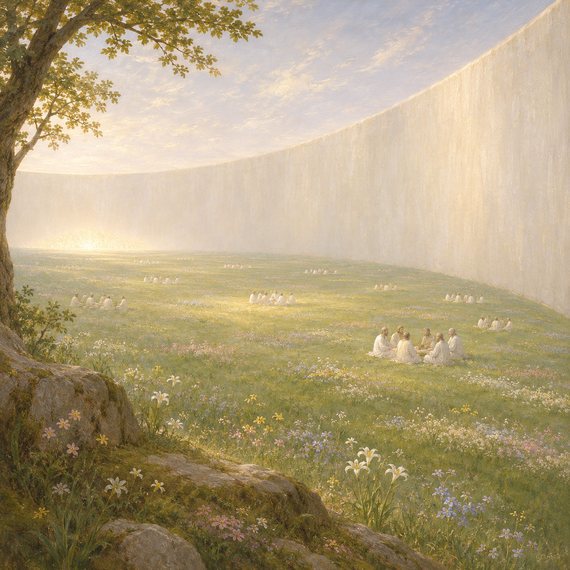
Beyond the meadow came greater brightness, sweeter scent and singing. Dryhthelm hoped they would enter, but his guide stopped and turned back. The story Bede preserves is explicitly Christian: the regions have moral meanings, and the guide eventually explains them. Its route is nevertheless strikingly particular. The traveller moves through changing conditions, reaches a structure he cannot pass, crosses it by an unexplained means, and approaches a further place which he is not permitted to enter. The journey includes both a view and the frustration of a view withheld.
Bede learned the details through a priest named Hemgils, preserving a journey whose changes of direction remain vivid across the centuries. A guide turns away, darkness closes around the traveller, and an immense wall offers no apparent entrance. Those moments bring the reader close to Dryhthelm’s bewilderment. The country’s meaning was gradually revealed to him, while his desire to reach its brighter regions kept pulling him onwards.
The sky inside the fall
Albert Heim's account of a fall in the Swiss Alps offers a very different setting. Writing in the Swiss Alpine Club's yearbook in 1892, the geologist described an early-1870s descent on the Säntis. While sliding down snow, he tried to hold on to his hat and lost control. He struck rock and fell through the air to snow below. Within the few seconds of the fall, he recalled an extraordinary succession of thoughts, memories and perceptions. He considered the ground beneath the cliff, the consequences for his companions and family, and even a forthcoming lecture he might be unable to deliver.
Then his past appeared before him in images, as though on a stage. He saw himself taking part. Events remembered as painful no longer brought the same distress. A beautiful blue sky with pink and delicate violet clouds increasingly surrounded him. He described floating gently into it while still seeing that he was falling towards a snowfield. The external accident and the enveloping scene did not politely take turns. His account places observation, thought and feeling alongside one another, ending with the sound of impact.

Heim initially believed he had called to his companions immediately afterwards. They told him he had been unresponsive for roughly half an hour. That missing interval sits beside the apparent abundance of experience during the much shorter fall. His yearbook paper also collected other survivors' recollections, but the detailed account of his own accident is especially arresting because the landscape changes without his ceasing to know that he is in danger. He did not have to arrive at a gate or meet a guide for ordinary space to become something stranger.
What lay beyond the rocks
Wiltse became curious about the other side of his boundary. He knelt at openings between the rocks and looked through. Beyond lay a green, cool country, with the road and valley curving away before he could see far. He even pressed an ear to the stone, trying to hear through it. At what he understood to be the frontier between lives, the physician listened for the world beyond.
He eventually attempted to edge around a rock and cross the line. A small black cloud came towards his face; his ability to move and think failed. The next thing he described was opening his eyes on the cot. Recovery from the illness still lay ahead. His remembered expedition had ended before the landscape disclosed its destination.
These accounts give the recent interest in drawing such spaces a rich and sometimes disquieting background. Dryhthelm's wall, Heim's enveloping sky and Wiltse's road are far from interchangeable scenes. Their differences deserve as much attention as the recurring movement towards light or an apparent boundary. Each story keeps the perspective of someone who was there only briefly and came back with an incomplete view. Wiltse could describe the stones in his road and the country bending beyond them. He could tell what he had tried to hear. The part that lay around the bend remained out of sight.
Further Reading
- The 2026 study of remembered spaces
- Wiltse’s original account
- Bede’s account of Dryhthelm
- Albert Heim’s 1892 paper
Albert Heim’s work and the experience of dying from falls are among the subjects explored in the Plus+ extension of episode 28.04, Wholesome Chaff. Join Mysterious Universe Plus+ at the Max tier to stream the extended episode and the available back catalogue.
Trending Podcasts
-
 36.13 I MU Podcasts
36.13 - MU Podcast - MU Interviews - Charlie Robinson - 002
-
-
-
 36.14 I MU Podcasts
36.14 - MU Podcast - The Tayos Caves Mystery Part 1
-
 36.16 I MU Podcasts
36.16 - MU Podcast - Beneath the Pyramids
-
 36.19 I MU Podcasts
36.19 - MU Podcast - MU Interviews - Joshua Cutchin - 003

Julian Vale writes about strange encounters, unexplained events and the mysteries of remote places. His features bring together eyewitness accounts and overlooked stories, following the connections between experiences separated by time and geography.
Previous article