

Dec 25, 2025 I Brent Swancer
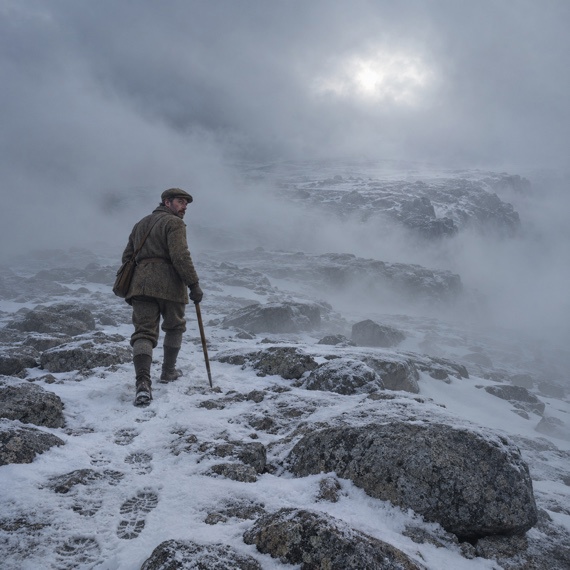
Descending through mist on Ben Macdui, Norman Collie began to hear footsteps behind him. Every few steps he took were followed by a heavier crunch, as though another walker were covering the same ground with a much longer stride. He could see nobody. He listened again, tried to dismiss what he was hearing, and continued down the mountain. The sounds continued too. Eventually, the experienced mountaineer became so frightened that he fled, stumbling among the boulders for miles towards Rothiemurchus Forest.
Collie later described the experience at a Cairngorm Club gathering in 1925. His account became closely associated with the Big Grey Man of Ben Macdui, although the encounter itself contained no sighting of a grey figure. There was no face in the mist, no looming body and no glimpse of something retreating behind the rocks. What disturbed him was the apparent movement of an unseen walker, keeping pace behind him with strides far greater than his own.
The absence of a visible figure left him with little to describe beyond the sounds and his reaction to them. Yet the experience had been powerful enough to send him running across difficult ground. Whatever had accompanied him down the mountain, he had no desire to meet it again alone.
Other visitors to Ben Macdui would describe encounters with a similarly elusive presence. Some heard footsteps. Others felt watched, or experienced a sudden change in their emotions that became almost impossible to resist. These accounts helped give the mountain a reputation for something more troubling than an occasional strange shape in the clouds. The presence could apparently make itself known without taking any recognisable form.
One of those who reported such an experience was mountain rescuer Peter Densham. During rescue work in May 1945, he stopped near the summit and became aware of a change around him. Mist enveloped the mountain, and he felt that someone was watching. Then came the sound of footsteps crunching through the snow. Densham, like Collie before him, left in fear.
There is an uncomfortable intimacy to these encounters. A distant figure can be watched, approached or avoided. Footsteps close behind suggest that the encounter is already under way. The person hearing them must decide whether to stop and wait, turn towards something they cannot see, or continue with the knowledge that it appears to be following.
Densham also described a stranger episode involving fellow rescuer Richard Frere. On this occasion, the apparent visitor did more than walk nearby. Frere began speaking as though engaged in conversation, and Densham subsequently found himself participating. For a time, the two men apparently behaved as though there were three people present. Afterwards, they could neither identify the other participant nor recall what the conversation had concerned.
The account leaves frustrating gaps. There is no remembered message to examine, no description of the supposed speaker and no clear account of its departure. The unsettling detail is the shared assumption that someone else had been there. Only afterwards did the absence become apparent.
Frere’s other reported experiences on Ben Macdui included an oppressive despair that seemed to overtake his own thoughts. Leaving could itself become difficult, as though the will to act had been weakened. Fear followed as he finally made his way away from the mountain.
Together, these stories describe an encounter that could begin before a walker had seen or heard anything unusual. The first warning might be a feeling: the certainty of being watched, an unwelcome change of mood, or the conviction that somebody was standing close by. An explanation could come later, if it came at all. On the mountain, the immediate concern was getting away.
But an unseen companion has not always been something to escape. Elsewhere, explorers have described an equally convincing sense of company that brought reassurance rather than dread. One of the best-known accounts came from Ernest Shackleton after his crossing of South Georgia in 1916.
Shackleton made the journey with Frank Worsley and Tom Crean, travelling across mountains and glaciers to reach help. During the exhausting thirty-six-hour crossing, he repeatedly felt that another person accompanied them. There were three men, but to Shackleton the party seemed to contain four.
He said nothing about it during the march. Afterwards, Worsley mentioned that he too had felt someone else travelling with them, and Crean acknowledged the same impression. Shackleton understood their survival in terms of Providence and included the experience in his account of the expedition, despite the difficulty of describing it.
His additional companion had no recorded face or voice. There was no encounter with a stranger who subsequently disappeared. The experience lay in the persistent sense that their small party contained another member.
Set beside Collie’s account, the contrast is striking. Both men described company they could not see, but the emotional character of that company was entirely different. On Ben Macdui, Collie believed something was following him and fled. On South Georgia, Shackleton remembered an additional presence within the party as part of a journey he believed had been guided.
That difference becomes even more pronounced in the experience of Frank Smythe on Everest in 1933. While climbing alone, Smythe felt accompanied by a second person. The impression relieved his loneliness and gave him a sense of protection. He even felt as though a rope connected him to his companion, who would hold him if he slipped.
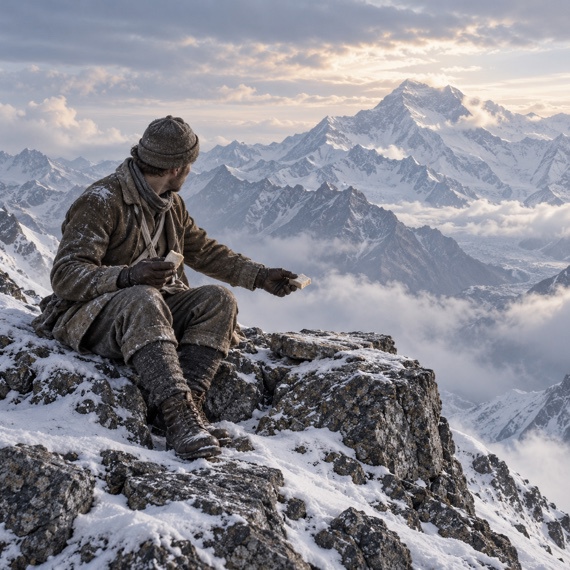
The presence became so familiar that, when Smythe stopped to eat some mint cake, he divided it and turned to offer half to the person beside him. Finding nobody there came as a shock.
It was an ordinary gesture made in extraordinary circumstances. For that moment, sharing food seemed appropriate because another person seemed to be present. Smythe described the company as friendly and helpful, something that sustained him during his solitary climb. An account reproducing his description was already in print in 1934.
There is a resemblance here to Densham and Frere’s apparent conversation on Ben Macdui. In both stories, the experience extended into social behaviour. Smythe offered food; the rescuers reportedly spoke with an additional participant. These were actions people normally perform in company, undertaken before the absence of another person fully asserted itself.
The resemblance does not make the encounters identical. Smythe’s companion offered comfort. The Ben Macdui accounts belong to a much more uneasy collection of experiences, and the conversation remembered by Densham and Frere remained almost entirely inaccessible afterwards. What connects them is the ease with which an apparently empty place became occupied.
The most memorable detail in Smythe’s story may be the half portion held out for someone who was not there. It gives a physical expression to an experience that otherwise remains difficult to picture. Shackleton could describe an extra member of the party; Collie could describe the rhythm of footsteps. Smythe could remember turning with food in his hand.
Such details also complicate the familiar image of a wilderness haunting. These visitors did not necessarily appear as translucent figures or speak in disembodied voices. Sometimes there was only a relationship: someone following, someone watching, someone walking alongside. The person undergoing the experience seemed to know where the other presence belonged even when there was nothing to look at.
On Ben Macdui, that relationship was often threatening. The footsteps remained behind the walker. The watching presence made a familiar activity suddenly intolerable. In Smythe’s account, the companion belonged beside him, close enough to share his food and apparently capable of arresting a fall. For Shackleton, the presence belonged among the men making the crossing.
Whether dreaded or welcomed, the additional traveller could become part of the journey without an introduction. Nobody had to watch it approach. There might be no identifiable moment when solitude ended, only a growing awareness that it had.
This is what gives the accounts their peculiar persistence. The landscape need not change. A climber can still recognise the slope, the snow and the route ahead while becoming convinced that his circumstances have altered completely. He is no longer alone, or the party is no longer the size it was when it set out.
Collie’s experience left him unwilling to return alone. Smythe’s was reassuring enough that he tried to share his provisions. Shackleton remembered the presence when writing about the survival of his companions. Each carried something different away from the encounter, but all described journeys in which the number of travellers seemed uncertain.
Somewhere among the footsteps, the conversation and the offered food is an elusive kind of encounter: a stranger who may never be seen, yet becomes, for a time, as immediate as the person walking beside you.
Further Reading
Norman Collie and Ben Macdui Royal Scottish Geographical Society.
Ernest Shackleton’s unseen companion South, Chapter X.
Frank Smythe’s Everest experience “His Unseen Companion,” Light, 5 October 1934, page 602.
More Encounters to Explore
Who, or what, comes to someone’s aid when survival seems impossible? Mysterious Universe 21.20 explores the stranger side of the Third Man Factor, including an account of a mysterious rescue followed by an apparent haunting. Join Mysterious Universe Plus+ at the Max tier to stream the episode and delve into the available back catalogue of extraordinary experiences.
Trending Podcasts
-
 36.13 I MU Podcasts
36.13 - MU Podcast - MU Interviews - Charlie Robinson - 002
-
 36.14 I MU Podcasts
36.14 - MU Podcast - The Tayos Caves Mystery Part 1
-
 36.12 I MU Podcasts
36.12 - MU Podcast - The Skill Trap | Outsourcing Ourselves
-
-
 36.11 I MU Podcasts
36.11 - MU Podcast - This Hollow Earth - Episode 01: Deep Lore
-
 36.16 I MU Podcasts
36.16 - MU Podcast - Beneath the Pyramids
Latest Articles

Julian Vale writes about strange encounters, unexplained events and the mysteries of remote places. His features bring together eyewitness accounts and overlooked stories, following the connections between experiences separated by time and geography.
Previous article
Related Articles