




Nov 23, 2026 I Rowan Ashford
Maud Turner thought she might finally have found an explanation for the noises. After weeks of knocking in her Oxfordshire cottage, something had begun to whistle. Then, while the family were having breakfast on 1 February 1919, they heard a muffled voice. Perhaps a parrot had escaped and found its way into the building. Maud invited the supposed bird to come down and eat with them.
The answer was clear enough to be understood, but not comforting. The voice said it had breakfast at the YMCA. Before the day was over, it would be repeating a private conversation to an embarrassed visitor, giving itself a name, and making demands for money. The unseen caller became Willie. For the Turner family, a house troubled by unexplained sounds had become a house in which somebody appeared to be listening.
The account survives in a file called The Unfound Voice in the Society for Psychical Research’s archive. Historian Stephen Miller has revisited it in a three-part investigation for The Poltergeist Project, reconstructing the family’s circumstances alongside the disturbing narrative. His research brings forward a case whose central presence was never a clearly seen apparition. Willie made himself known through his conversation.
Hear the Highmoor investigation from the beginning
Cotton across the paths
The disturbances began in early December 1918, in a gamekeeper’s cottage connected with the Joyce Grove estate near Nettlebed. Maud lived there with her daughters. Her husband, known as Fred, had died during the First World War. The family were trying to continue their lives in the home associated with his work when knocking began to interrupt the nights.
Maud’s first thoughts were practical. Perhaps a neighbour’s goat was loose and knocking with its horns. When that explanation failed, she considered children playing tricks. Early one morning, during a quiet interval, she stretched cotton across the approaches to the cottage. Whoever was coming to make the noises would have to disturb her makeshift tripwires.
The knocking resumed, but the cotton remained intact. Neighbours joined the attempts to find a source. Floorboards were lifted, traps were laid and watches were kept. Meanwhile, the noise became difficult to escape. Maud moved out of her bedroom to sleep elsewhere in the house, only to find that the banging followed her. The effort to restore an ordinary night’s rest had already drawn other estate workers into the cottage.
Then the sounds changed. Towards the end of January, a man’s whistling was heard with the knocks. At breakfast the following Saturday came the muffled speech and Maud’s invitation to the supposed parrot. There is something especially disquieting about that small domestic gesture. She was offering a place at the table to what she hoped was a troublesome animal. The reply introduced a stranger instead.
The search itself became part of family life. A noise might be brief, but checking the garden, asking neighbours to sit up and changing sleeping places carried its consequences into the following day. Long before Willie supplied a name, the disturbance had made the cottage a place that required watching.
A visitor who repeated the gossip
Maud initially kept looking for a bird. Neighbours helped with the search, and she apparently contemplated keeping the elusive creature as compensation for the trouble. Nothing was found. The voice, however, continued to answer. Sometimes it echoed the language used for a pet parrot. At other times it introduced Willie, a character who claimed to have known her dead husband.
That afternoon, Maud and a neighbour discussed a mutual acquaintance over tea. When the acquaintance visited later, the voice reportedly repeated what had been said about her. The intrusion was no longer confined to sounds behind the walls. It had entered the relationships between the people sitting in the room, exposing a conversation its participants had expected to remain private.
Willie’s other remarks were less mischievous. He wanted money and threatened to kill to obtain it. He named 6 February as the day he would come for it. He also claimed to have a letter and a family photograph from Fred, including a picture the soldier had taken abroad. The promises and threats put an unnerving personal shape around the otherwise unlocated voice.
Miller’s later research follows Fred’s military service rather than accepting Willie’s claimed identity. Fred had served before the First World War and later belonged to the Machine Gun Corps. One of the men killed with him was named William, a correspondence Miller notes without identifying that soldier as the voice. The possible connection adds poignancy to Willie’s claim, while leaving the speaker’s identity unresolved.
Money out of the house
By Sunday, the voice was directing threats at the children. On Monday, Maud’s elder daughter asked for paper so she could communicate without being overheard. She wrote that she did not believe the speaker was a parrot: she thought it was a man. She wanted her money box brought quickly.
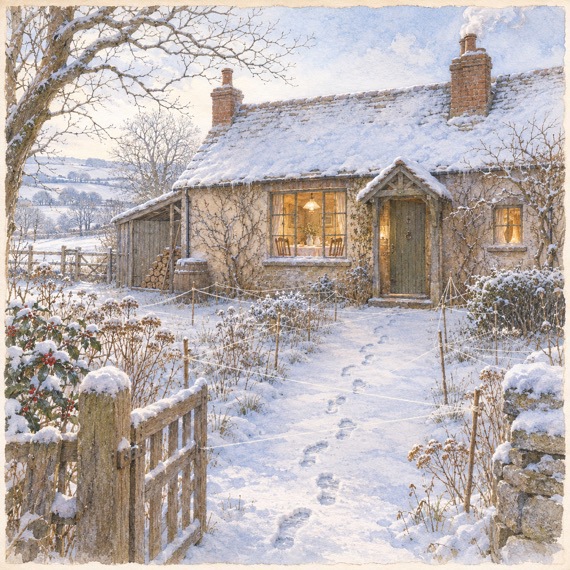
Maud gathered the family’s money, left the children with neighbours and walked through snow to the estate office to put it somewhere safe. On her return, she met Kate Fleming, whose husband owned Joyce Grove, and explained that she needed to leave the cottage. Fleming and her companion treated the story as a possible concealed intruder. A police officer and the carpenter who knew the cottage’s construction were brought into the search.
The snow seemed to offer a useful check. The family’s footprints were visible, with no other tracks indicating someone had left. The searchers examined the building’s cavities, floor spaces and roof. They found nobody. With no speaker to remove, arrangements were made for Maud and the children to stay in another cottage. The attempt to apprehend a hidden man ended without one.
The voice was not reported again after the family’s return. What followed was a separate, devastating event: influenza entered the household, and the younger daughter, Frances, died later that February. The pandemic brought a grief of its own into a household already exhausted by the disturbances. Maud and her surviving daughter subsequently left the area.
The record reached the SPR through Barford, a local governess who spoke with Maud and neighbours and sent her report to Sir Oliver Lodge. Miller traces that correspondence as well as the family history. The surviving story is consequently a recollection gathered soon afterwards, preserved in writing rather than a recording of the voice. Its personal details have outlasted the cottage’s brief, unwanted conversational guest.
Another household learns to answer
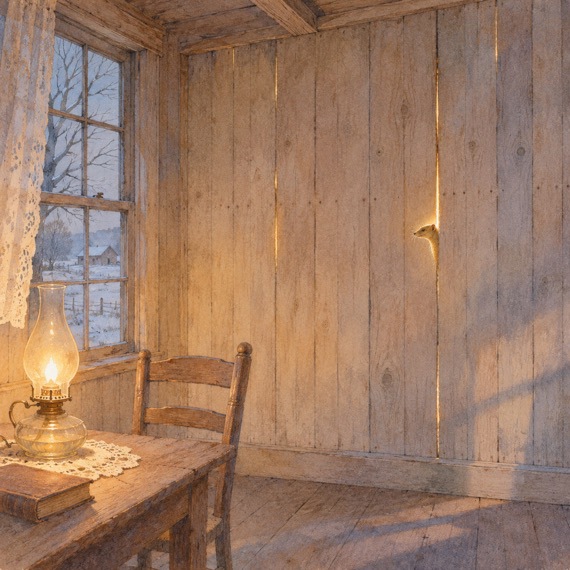
Just over a decade later, a family on the Isle of Man described a different progression from animal sounds to speech. James and Margaret Irving and their daughter Voirrey lived at Cashen’s Gap, where they reported an unusual small creature and noises behind the wooden interior partitions. According to the archival research of Christopher Josiffe, the sounds developed into nursery rhymes and conversation.
The supposed animal became Gef, the talking mongoose. Its claimed accomplishments grew to include listening to people away from the farm and returning with information. Josiffe’s account describes a voice that was high and sharp, unlike the gruff presence reported at Highmoor. Yet both stories gave their families a talkative companion whose location and nature remained difficult to settle.
In each household, the first response involved an animal. Maud imagined a stray parrot; the Irvings described a weasel-like visitor. Speech transformed the encounter. The question was no longer only what might be moving behind a wall, but what it knew, what it wanted and whether it could be persuaded to stop. A voice could be addressed, and addressing it could draw the household further into its company.
A voice that claimed the room
Enfield supplied a much later and extensively recorded example. In December 1977, months into the Hodgson family’s disturbances, whistles and barking sounds associated with Janet developed into a harsh elderly male voice. It identified itself as Bill Wilkins and claimed to have lived in the house. Investigators recorded its exchanges and tried several ways of examining how it was being produced.
Here the important difference is that the voice was associated with a person. The Highmoor account describes an unlocated speaker; Enfield’s voice emerged through Janet. The SPR’s account preserves both the investigators’ conviction and the disagreement over the vocal phenomena. It remains possible to hear the recorded exchanges, rather than relying entirely on someone’s description of what a voice sounded like.
The comparison is compelling without requiring Willie, Gef and Bill to be the same kind of presence. Each acquired an identity through interaction. Each changed how people behaved within a home. The personalities mattered: a witty or irritating speaker invited a different response from one that demanded money or threatened children. Whatever their origins, these were encounters that their participants experienced as relationships.
Highmoor’s particular unease lies in the failure of familiar responses. Maud searched for an animal, tested the paths for pranksters, sought help and eventually removed her savings. The people who came to assist searched for a man. None of those actions produced someone they could confront. What remained was a name, a sequence of remarks, and the memory of a voice that had entered the family’s meals and nights without ever taking a place they could see.
Further Reading
The Highmoor Poltergeist, Episode One
The Highmoor Poltergeist, Episode Two
The Highmoor Poltergeist, Episode Three
Continue into the peculiar company of Gef in Secret Cities, Space Brothers & Talking Mongooses. Join Mysterious Universe Plus+ at the Max tier to stream the episode and explore the available podcast back catalogue.
Trending Podcasts
-
 36.13 I MU Podcasts
36.13 - MU Podcast - MU Interviews - Charlie Robinson - 002
-

-

-
 36.14 I MU Podcasts
36.14 - MU Podcast - The Tayos Caves Mystery Part 1
-
 36.16 I MU Podcasts
36.16 - MU Podcast - Beneath the Pyramids
-
 36.19 I MU Podcasts
36.19 - MU Podcast - MU Interviews - Joshua Cutchin - 003

Elias Mercer writes about unexplained phenomena, unusual encounters and the stories that gather around mysterious places. His features connect contemporary reports with older accounts, exploring the details that make them worth remembering.
Previous article