

Nov 20, 2026 I Rowan Ashford
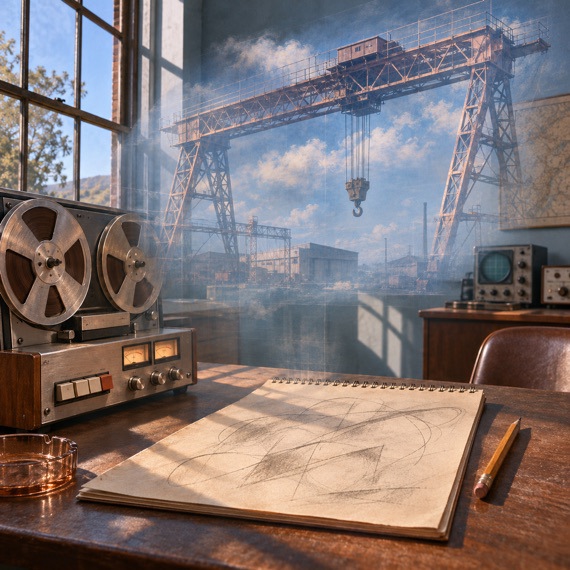
Pat Price drew a crane. In the story Russell Targ would return to throughout his life, this was a particularly awkward object to explain: a large industrial gantry at a Soviet research installation, represented on paper by a man sitting in California. There were many more glamorous possibilities for psychic espionage. This one involved rails, supporting legs and the shape of heavy machinery. Its very lack of glamour helped make it memorable. The question was how those particular features had found their way into the drawing.
Targ, who died on 16 November at the age of 92, spent much of his life making room for questions like that. With fellow physicist Harold Puthoff, he established the remote-viewing research programme at Stanford Research Institute in 1972. Their work became an early part of the much larger government effort now remembered under the name Star Gate. To the public, it brought a remarkable possibility into view: that someone might perceive a distant place without travelling there, receiving a photograph or being told what it contained.
For readers meeting the crane story for the first time, see the original drawing and target comparison here. The comparison on Targ’s website uses a CIA drawing based on satellite photography. It is worth looking closely, rather than accepting a description of what the pictures supposedly show. That invitation to look is an appropriate place to begin remembering him.
A physicist willing to listen
Before the intelligence contracts, Targ worked on lasers. He studied physics at Queens College and undertook graduate work at Columbia, then pursued a technical career that eventually brought him to California. His later work at Lockheed included airborne laser systems designed to detect wind shear. These were practical questions about obtaining information from a world that could be dangerous precisely because something important lay beyond immediate human perception.
Psychic research asked a different question, but it also concerned information: where it came from, how it was received and whether it could be recorded before anyone supplied the answer. Targ’s interest was not simply in a person declaring that something extraordinary had happened. He wanted a session, a record and a target against which that record could be compared. Whatever conclusion a reader reaches about remote viewing, those surviving records give the subject a substance that an anecdote told years afterwards cannot always provide.
His willingness to investigate also had a personal history. As a boy he became interested in stage magic after seeing Harry Blackstone perform. His son Nicholas later recalled that the young magician sometimes felt he was obtaining information beyond what his tricks should have provided. It was a curious beginning for a psychic researcher: familiarity with illusion accompanied by an interest in experiences that seemed to fall outside it. The possibility that something unusual might be happening remained with him long after childhood.
Across the laboratory door
The SRI experiments gave an unfamiliar idea a deliberately ordinary setting. Someone remained at the laboratory while other researchers travelled to a location. The person left behind described impressions and made drawings; afterwards, those records could be considered alongside the actual destination. The separation mattered. A vivid description of a place would mean little if it had arrived after the visitor returned with photographs and an account of the afternoon.
In their 1976 paper in the Proceedings of the IEEE, Puthoff and Targ described a series using targets around the San Francisco Bay Area. Management selected destinations from sealed envelopes; the researcher sitting with the viewer was also kept ignorant of the target. The researchers sought something that could survive being written down and examined by people outside the session. Their paper included successful correspondences, mistakes and attempts to judge the material systematically.
One especially interesting participant was the photographer Hella Hammid. She had taken part in an earlier laboratory experiment, but arrived at the viewing series without a history of reported psychic functioning. At a pedestrian-overpass target, she described an elevated trough and drew nested shapes corresponding to a view through the structure. In another session, she described a roofed, slatted building; the target was a bicycle shed. The authors presented these as examples of a newcomer producing recognisable visual material.
Hammid deserves a place beside the better-known names. Her involvement broadens the story beyond the exceptional psychic recruited for exceptional work. A photographer was being asked to attend to an impression and represent it, even when she could not identify what it meant. Her examples also expose a difficulty familiar to anyone who has tried to describe a half-remembered dream: a shape may be easier to retain than an explanation. A trough could be a first attempt to communicate a walkway seen from an unfamiliar angle.
That possibility was central to the appeal of Targ’s work. An impression did not have to arrive as a complete photograph, with a caption attached. It might be partial, awkward and difficult to name. The patient work lay in recording it before an interpretation took over. The resulting pages can feel unusually intimate: they preserve someone trying to describe a place that, according to the experiment, they had no ordinary means of seeing.
What remained on the page
The Soviet gantry experiment brought that question into a much less ordinary setting. Price’s four-day viewing of the site designated URDF-3 took place in July 1974. A later declassified analysis judged the overall experiment unsuccessful, recording errors and information supplied to him by the experimenters. That assessment belongs in the story. In particular, Price received a telephone call after the first session directing his attention towards the crane and other features. The famous drawing did not emerge from four days without feedback.
Yet the same analysis identified his second-day sketch of the rail-mounted gantry as the strongest positive evidence in the exercise. Its author found the likeness sufficiently striking to consider remote viewing or an informed source as possible explanations. The controls did not eliminate the latter. Even in a report with an unfavourable overall conclusion, the drawing remained a problem worth discussing. The archive preserves both the unsuccessful elements and the feature that continued to intrigue Targ.
This is a more interesting legacy than the polished version in which every session becomes a triumph. It lets us approach the work as an encounter with something its participants were trying to understand. A surprising drawing does not become less surprising because the surrounding file is complicated. Nor does a tribute require the complications to disappear. Targ gave decades to following the moments that seemed to him to reach beyond ordinary perception, and to bringing those moments before a wider audience.
The industrial setting adds something distinctive to the case. There is no apparition, message from a deceased relative or emotionally familiar location here. The proposed connection reaches towards an impersonal structure at a distant facility. If such perception occurs, these sessions suggest it need not confine itself to the meaningful places of a person’s own life. That was a large part of the challenge Targ placed before his readers: why should the apparent reach of awareness stop where familiar experience says it must?
Russell takes the chair
Among the examples Targ preserved on his own website is a quieter scene. With Price absent, the physicist took the viewer’s role himself. The target was an island airport in the San Andrés area of Colombia. His sketch included a runway ending towards the ocean. On the same page as Price’s crane, the comparison shows Targ moving from the position of researcher to that of participant. He was willing to attempt the thing he was asking others to do.

There is something appealingly direct about that example. A distant runway, the water beyond it, a person elsewhere attempting to describe the arrangement: the elements are easy to grasp. The original comparison is available through the earlier link. Readers can spend time with the actual material rather than an increasingly elaborate retelling. It is one reason the drawings remain such an effective introduction to his work. They bring an enormous question down to a few marks on paper.
Targ subsequently helped carry that question outside the laboratory. Mind Reach, written with Puthoff, appeared in 1977; later books included Limitless Mind and his memoir Do You See What I See? The range of his writing extended into Buddhism and the wider implications of consciousness. His work reached people who would never read an intelligence assessment or a technical journal. For many, he became the person who made remote viewing seem like a subject they could approach, rather than an inaccessible secret programme.
Remembering the man
His family’s recollections supply a welcome scale for a life so often described through extraordinary claims. Nicholas told the Almanac that his father took well-founded criticism seriously, whether it concerned ESP or the chocolate-chip cookies he baked for his children. That detail is worth keeping. Behind the familiar name was someone whose curiosity shared a household with ordinary affection, experiments in the kitchen and the willingness to hear that something could be improved.
Honouring Russell Targ means remembering that sustained curiosity, as well as the crane and the distant runway. He helped create a setting in which people could describe experiences that might otherwise have been dismissed before they were recorded. He published, argued, demonstrated and returned to the question over many years. The work remains open to investigation, and its most arresting records remain available to anyone prepared to look. He leaves us with those pages, and with the invitation that gave them life: pay attention to what a person actually perceived, then follow the question as far as it will go.
Further Reading
Russell Targ remembered by his family
Remote-viewing drawings and target comparisons
SRI remote-viewing research, 1976
Analysis of the URDF-3 experiment
Russell Targ’s books and scientific career
Hear Russell tell the story himself in our conversation with him on episode 9.14 of the Mysterious Universe podcast, including further discussion in the extended show. Join Mysterious Universe Plus+ at the Max tier to stream this episode and explore the available back catalogue.
Trending Podcasts
-
 36.13 I MU Podcasts
36.13 - MU Podcast - MU Interviews - Charlie Robinson - 002
-
-
-
 36.14 I MU Podcasts
36.14 - MU Podcast - The Tayos Caves Mystery Part 1
-
 36.16 I MU Podcasts
36.16 - MU Podcast - Beneath the Pyramids
-
 36.19 I MU Podcasts
36.19 - MU Podcast - MU Interviews - Joshua Cutchin - 003
Elias Mercer writes about unexplained phenomena, unusual encounters and the stories that gather around mysterious places. His features connect contemporary reports with older accounts, exploring the details that make them worth remembering.
Previous article
Related Articles