



Dec 18, 2025 I Brent Swancer
On a shopping trip to Liverpool in July 1996, a man called Frank went to meet his wife at a bookshop and found a different shop in its place. According to the account collected by local writer Tom Slemen, the sign said Cripps. The window displayed women’s handbags and shoes. A small, old-fashioned van had just passed him, sounding its horn, and the people around him appeared to be wearing clothes from the 1940s or 1950s.
A young woman in contemporary clothing provided a reassuring exception. Frank followed her through the shop entrance, where the scene became Dillons bookshop again. She too had expected a clothing shop. His wife, waiting inside, had noticed nothing unusual.
The account leaves the doorway as a peculiar dividing line. On one side was a street Frank believed belonged to an earlier period; on the other was the afternoon he had been having before the interruption. There was no machine, no announced destination and no deliberate attempt to travel anywhere. He had been trying to join his wife.
This is the setting of many reported time slips. Someone takes a familiar route or makes an ordinary excursion, then notices something that no longer fits. The place may remain recognisable while its occupants, buildings or atmosphere appear to belong elsewhere. Sometimes the supposed past is recognised immediately. Sometimes it takes weeks, or years, for the witness to decide what the experience might have meant.
Long before the Liverpool story circulated, two English women had published a much more extensive account of an afternoon that troubled them in precisely this way. Charlotte Anne Moberly and Eleanor Jourdain visited Versailles on August 10, 1901. They toured the palace, consulted their guidebook and decided to walk to the Petit Trianon. Neither claimed to know the grounds well. Their excursion began with uncertainty about directions, rather than an expectation of anything uncanny.
Writing under the names Elizabeth Morison and Frances Lamont, they eventually described the visit in An Adventure, published in 1911. The book gives each woman’s recollection separately. Read that way, their experience is less like a single polished ghost story than two people trying to compare the contents of an afternoon they had shared.
Moberly remembered taking an unnecessarily long route through the grounds. They passed the Grand Trianon, crossed a broad green drive and continued into a lane. She noticed a woman shaking a white cloth from a window and wondered why Jourdain did not ask her the way. A little farther on, they looked through an open doorway and saw a carved staircase. There was nobody to question, and they did not go inside.
At a choice of three paths they approached two men, whom they later referred to as gardeners. Moberly remembered long greyish-green coats and small three-cornered hats. Their appearance struck her as more dignified than the label gardener suggested. The men directed the visitors straight ahead.
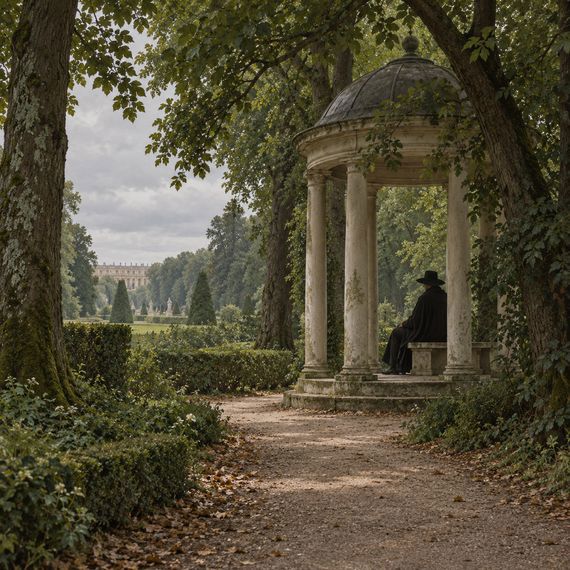
By then, she said, a feeling of depression had settled over her. She had enjoyed the walk and did not feel tired, but the gloom deepened as they approached a junction. Ahead stood a small circular garden kiosk among trees, with a seated man nearby. The trees themselves seemed wrong. They appeared flat and lifeless, like a scene worked into a tapestry, without the familiar play of light and shade. The wind no longer moved them.
The seated man wore a cloak and a broad hat. When he turned towards the women, Moberly felt alarmed and became determined not to take the path to the left. It was at this uncomfortable moment that they heard someone running towards them.
A second man appeared close by and urgently directed them another way. Moberly described dark curling hair, a flushed face and a cloak wrapped across him. She could not follow everything he said, but understood that he wanted them to turn right. They obeyed and crossed a small rustic bridge beside a thin fall of water. When she turned to thank him, he was no longer there, although she again heard running close by.
Beyond the bridge, a path led towards the Petit Trianon. Near its terrace Moberly saw a woman sitting on the grass, holding a sheet of paper out at arm’s length. She assumed the woman was sketching. A light hat rested on fair hair, and the dress appeared old-fashioned, though not so extraordinary that Moberly immediately assigned its wearer to another century.
The seated woman looked directly at her as they passed. Moberly found her presence irritating in a way she could not explain. She later noticed a pale green garment around the woman’s shoulders. Nothing in this part of the account resembles a transparent apparition. It describes a person apparently occupied with a sheet of paper, in a place where a visitor might reasonably stop to draw.
A young man then emerged from another building, slamming a door, and showed them the way round to the proper entrance. Inside, they followed a cheerful French wedding party through the rooms. The oppressive feeling lifted. They returned to Versailles for tea and then travelled back to Paris, without discussing the strange portion of their walk.
The delay is one of the most revealing features of their account. Moberly said that a week passed before she began describing their excursions in a letter and felt the same unpleasant atmosphere return. Only then did she ask Jourdain whether she thought the Petit Trianon was haunted. Jourdain agreed, and described a similar feeling of anxiety which she too had tried to conceal during the visit.
They had walked together, continued talking and asked for directions while each privately felt that something was wrong. Neither, according to their recollections, had understood the afternoon as an obvious journey into the past while it was happening. Their first attempt to name it was a haunting.
A further discrepancy emerged three months later. Moberly referred to the woman she had seen sketching, assuming that Jourdain remembered her. Jourdain said there had been no woman. Moberly protested that they had passed close to her, side by side. Jourdain remained certain she had seen nobody there.
Her own account contained other observations. Near the gardeners she remembered a woman passing a jug to a girl outside a cottage. Their clothing looked unusual to her. She also recalled the disturbing seated man, the hurried stranger and the little bridge. Near the terrace, although she saw no seated woman, she remembered drawing her skirt aside as though making room for someone, then wondering why she had done it.
The two descriptions overlap without becoming identical. The seated woman later became central to the story because Moberly associated her with Marie Antoinette. Yet that identification came afterwards, through discussion and historical investigation. During the walk she had taken the stranger for a tourist. Keeping that order intact preserves the oddness of the original encounter: the sight itself preceded the explanation attached to it.
The women also entertained an idea stranger than straightforward time travel. Perhaps, they wondered, they had somehow encountered a scene preserved in the queen’s memory. They connected the date of their visit with August 10, 1792, when the royal family’s circumstances changed violently in Paris. This was their proposed interpretation, rather than something the strangers in the garden had told them.
Nor did their interest end with the first afternoon. On January 2, 1902, Jourdain returned alone. The day was cold and wet. At first the grounds felt ordinary, but after crossing a bridge she experienced the old oppressive sensation again. Nearby she noticed two men loading sticks into a cart, wearing tunics and capes with pointed hoods. When she glanced away and back, both men and cart had disappeared from a space she thought she could see clearly.
Later, among the paths, she heard a rustling which suggested silk dresses. Turning, she saw nobody. She nevertheless felt crowded, as if people were passing close around her. Women’s voices and faint band music followed. She compared their diminished sound to a phonograph. Her return had produced another claimed experience, but it had not simply replayed the summer visit.
Elsewhere in England, a much later account also placed the first warning in the atmosphere of an otherwise ordinary walk. Andrew MacKenzie’s investigation of Kersey, Suffolk, concerned a walk through the village by three naval cadets in 1957. William Laing recalled church bells falling silent, unfamiliar-looking surroundings and ducks which appeared unnaturally still. A shop contained old carcasses. In Laing’s recollection, the visitors left in distress, then heard the bells again. Decades later, one companion also remembered an unusual experience, while the third recalled nothing of it.
The Kersey story is often labelled a visit to medieval England. That date is an interpretation of the scene, not a year supplied by someone the boys met. Its connection with Versailles lies partly in the witnesses’ descriptions of stillness and unease. In both, a walk became disturbing before a confident explanation was available. The place seemed altered as a whole, while its exact relationship to the past remained uncertain.
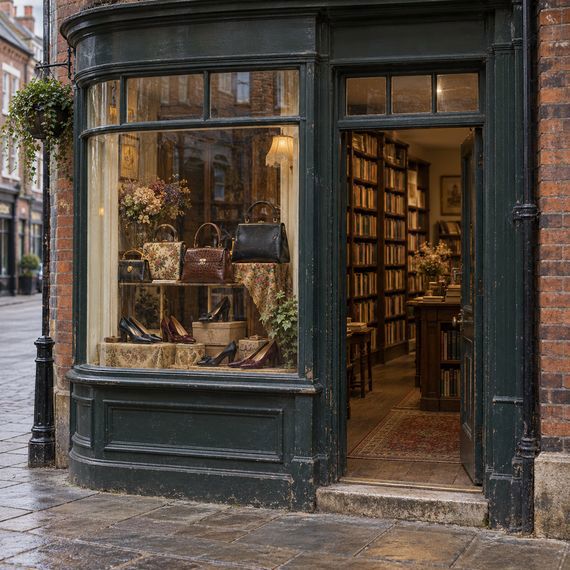
Liverpool offers a different ending. Frank’s account puts other people in the altered street and gives a shop entrance the role of bringing him back. It also contains a distinction worth retaining in the retelling: Slemen’s early version names the contemporary shop as Dillons. Later versions sometimes call it Waterstones. The familiar modern name can creep into an older story and change the very detail by which the witness recognised his own time.
That is why the smaller observations deserve attention. A hat, a shop display, an unexpected silence or a piece of paper can carry more of the experience than the grand explanation eventually placed over it. Moberly and Jourdain spent years comparing paths, buildings and recollections. Frank’s wife had simply continued waiting in a bookshop. The ordinary afternoon and the extraordinary account sit beside one another, without the neat separation a time-travel story might lead us to expect.
These witnesses described places they could leave and, at least in principle, visit again. The difficulty came with the return. A route could be retraced without recovering the same scene; a familiar entrance could open onto the expected shop after apparently belonging to another. For a few minutes the surroundings had seemed to follow different rules. Afterwards, the witness was left trying to explain why a perfectly ordinary place would not stay as it was.
Further Reading
Keep Listening
A Chicago elevator journey that seems to end somewhere impossible opens 30.17, Unseen Gateways, alongside accounts of phantom ships and strange disappearances. Choose Mysterious Universe Plus+ at the Max tier to stream the episode and follow more curious detours through the available back catalogue.
Trending Podcasts
-
 36.13 I MU Podcasts
36.13 - MU Podcast - MU Interviews - Charlie Robinson - 002
-
-
 36.14 I MU Podcasts
36.14 - MU Podcast - The Tayos Caves Mystery Part 1
-
 36.16 I MU Podcasts
36.16 - MU Podcast - Beneath the Pyramids
-
 36.12 I MU Podcasts
36.12 - MU Podcast - The Skill Trap | Outsourcing Ourselves
-
Latest Articles

Rowan Ashford covers strange creatures, hauntings and local legends. He takes a particular interest in older reports and the details that disappear as stories pass from one teller to the next.
Previous article
Related Articles